Your health & wellbeing
NHS App
The NHS App is free to download from your chosen app store and, once registered, you will be able to get your COVID pass, book appointments, order prescriptions, view your medical record including results and correspondence, and also access patient information and advice.
For more details, visit www.nhs.uk/nhs-app.
Long-term conditions
Asthma is a common condition that causes coughing, wheezing, tightness of the chest and breathlessness. Most people with asthma who take the appropriate treatment can live normal lives, but left untreated, asthma can cause permanent damage to the airways
Symptoms of asthma
The usual symptoms of asthma are
- coughing
- wheezing
- shortness of breath
- tightness in the chest
Not everyone will get all of these symptoms. Some people experience them from time to time; a few people may experience these symptoms all the time.
Treatment of asthma
There isn’t a cure for asthma. However, treatments are available to help manage your symptoms. Your treatment plan will be individual to you, combining medicines and asthma management in a way that works best for you.
Living with asthma
Medicines are only part of your treatment for asthma. You will also need to deal with the things that make it worse. Keep a diary to record anything that triggers your asthma – this can help you to discover a pattern. Using a peak flow meter to monitor your lung function can also help. If you have repeatedly low readings in a certain situation (for example, at the end of a working day, after exercise or after contact with an animal) this may indicate the trigger.
Useful Links
Asthma UK
This website has been revamped to meet the needs of the thousands of people with asthma who visit the site each day, either to find important information about asthma and how to control it
Asthma
An excellent resource with useful video, audio, images and references relating to asthma.
NHS Choices – Asthma
Further information about symptoms, treatment, causes and prevention of Asthma.
These links all come from trusted resources but if you are unsure about these or any other medical matters please contact your doctor or pharmacist for advice.
Cancer – Healthtalkonline
Healthtalkonline, an award-winning charity website, lets you share in other people’s experiences of health and illness. An excellent resource compiled after interviewing a wide range of people suffering from heart disease.
Cancer Research
Free information service provided by Cancer Research UK about cancer and cancer care for people with cancer and their families. Information is formatted in such a way that makes understanding the website an easy process
Macmillan Cancer Support
Europe’s leading cancer information charity, with over 4,500 pages of up-to-date cancer information, practical advice and support for cancer patients, their families and carers.
NHS Choices
Further information about symptoms, treatment, causes and prevention of Cancer
These links all come from trusted resources but if you are unsure about these or any other medical matters please contact your doctor or pharmacist for advice.
Coronary heart disease (CHD) is a preventable disease that was responsible for the deaths of 88,000 people in the UK in 2008 (British Heart Foundation CHD Statistics 2010). In all, 191,00 died from heart and circulatory disease in the UK. Death rates are highest in Scotland and North of England and lowest in the South of England. CHD is the biggest killer in the country.
Home Blood Pressure Monitoring
The BHS recommends that only properly validated BP monitors be used both in the clinic and at home. All the monitors listed on their website have been clinically validated. This means that all the machines, regardless of their cost, give reliable readings when used correctly. Please note that added cost does not equate to added accuracy.
Useful Links
NHS Choices
Further information about symptoms, treatment, causes and prevention of CHD.
British Heart Foundation
Our vision is of a world in which people do not die prematurely of heart disease. We will achieve this through our pioneering research, our vital prevention activity and by ensuring quality care and support for people living with heart disease.
Chronic obstructive pulmonary disease (COPD) is the name for a collection of lung diseases including chronic bronchitis, emphysema and chronic obstructive airways disease. The main symptom of COPD is an inability to breathe in and out properly. This is also referred to as airflow obstruction.
Useful Links
NHS Choices
Guide to the symptoms, diagnosis, treatment and risks of COPD from the NHS
British Lung Foundation
Information and guidance on living with COPD
These links all come from trusted resources but if you are unsure about these or any other medical matters please contact your doctor or pharmacist for advice.
Diabetes is a long-term (chronic) condition caused by too much glucose (sugar) in the blood. It is also known as diabetes mellitus. There are two types of diabetes – type 1 and type 2.
According to the charity Diabetes UK, more than two million people in the UK have the condition and up to 750,000 more are believed to have it without realising they do.
More than three-quarters of people with diabetes have type 2 diabetes mellitus. This used to be known as non-insulin dependent diabetes mellitus (NIDDM) or maturity-onset diabetes mellitus. The number of people with type 2 diabetes is rapidly increasing as it commoner in the overweight and obese, which is itself a growing problem.
The remainder have type 1 diabetes mellitus, which used to be known as insulin-dependent diabetes mellitus.
What’s the treatment for diabetes?
It’s recognised that the sooner the blood sugar levels are brought under control, the better the long term prospects of preventing damage. Lifestyle advice about diet, weight management and regular activity is the first step.
Type 1 diabetes will require immediate insulin therapy, Type 2 diabetes will first be managed with a drug called Metformin, if lifestyle changes alone aren’t effective. There are now several other drugs used in type 2 diabetes, although eventually some type 2 diabetics will need insulin therapy as it’s a progressive disease
Mental health is about how we think, feel and behave. One in four people in the UK have a mental health problem at some point in their lives, which affects their daily life, relationships or physical health.
Mental health disorders take many different forms and affect people in different ways. Schizophrenia, depression and personality disorders are all examples of mental health problems. Diseases such as Alzheimer’s and dementia generally develop in old age, whereas eating disorders are more common in young people.
Osteoarthritis is the most common type of arthritis, affecting 8.5 million people in the UK. It develops gradually over time, causing joints to become stiff and painful. It can affect any joint but commonly affects the hands, knees, hips, feet and spine.
Who develops osteoarthritis?
Osteoarthritis usually develops in people who are over 50 years of age, and it is more common in women than in men. It is commonly thought that osteoarthritis is an inevitable part of getting older, but this is not true. Younger people can also be affected by osteoarthritis, often as a result of an injury or another joint condition.
Arthritis Research UK
Arthritis Research UK is the charity leading the fight against arthritis. Everything we do is underpinned by research
NHS Choices
Guide to the symptoms, diagnosis, treatment and risks of Ostearthritis from the NHS
The NHS website contains lots of useful information, tips and advice on living with chronic pain.
Help from your GP and use of NHS services dedicated to pain management can help make sufferers more independant, reduce the severity of pain and assist in day to day with coping with what can be a debilitating condition.
Useful Links
Back pain
Neuralgia
Complex regional pain syndrome
A stroke is a serious medical condition that occurs when the blood supply to part of the brain is cut off.
Like all organs, the brain needs the oxygen and nutrients provided by blood to function properly. If the supply of blood is restricted or stopped, brain cells begin to die. This can lead to brain damage and possibly death.
Strokes are a medical emergency and prompt treatment is essential because the sooner a person receives treatment for a stroke, the less damage is likely to happen.
The NHS Stroke Act FAST pages offer a great deal of information about stroke, including how to recognise the signs, some real stories of stroke sufferers and advice on how to live your life after a stroke.
Further help...
Important message regarding Covid booster vaccinations.
Eligible patients can now book their Covid-19 booster via the National Booking Service or by calling 119. The service is busy and operates a queueing system, so please be patient.
If you are experiencing any of the symptoms of COVID-19, it is important that you follow the up to date advice, which can be accessed at Coronavirus (COVID-19) – NHS (www.nhs.uk)
We may send you an invitation to book certain appointments such as Covid and flu vaccinations via text message. Please ensure that we have your up-to-date mobile telephone number for this purpose. << link to update your details page >>
Covid vaccine certification
We do not issue Covid vaccine certificates – proof of your vaccination status will be available on the NHS App, which can be downloaded for iPhone or for android. Alternatively, you can call the NHS helpline on 119 and ask for a letter to be posted to you.
Infection control measures
Health and care leaders say that strict infection control measures need to continue to be followed in healthcare settings. This will reduce the risk of vulnerable people from becoming infected and help prevent Covid outbreaks that could result in the temporary closure of a surgery. If you are experiencing respiratory or Covid symptoms, for the safety of staff and other patients we request that you continue to wear a face covering when attending the surgery.
Would you like more help to stop smoking?
The doctors at Mount Farm Surgery are keen to help you – please book a routine GP telephone call to discuss.
You may also find the following NHS web pages useful:
NHS Smokefree
Wellbeing Suffolk
Sexual Health
The more know about sex and relationships, the more confident you will feel when it comes to talking about it and the better decisions you will make. We would recommend visiting authoritative NHS websites such as the following:
iCash
Guide to sexual health services
If you need help now
If you need to consult with a doctor or nurse at Mount Farm Surgery you can be assured of a confidential, sensitive, and understanding service.
FeelGood Suffolk
Mount Farm Surgery works in partnership with FeelGood Suffolk to encourage patients to access their FREE services. FeelGood Suffolk is the integrated healthy lifestyle service for Suffolk to help local people live healthier lives.
Services on offer include help to stop smoking, adult weight loss, programmes for families and young people, and health walks. If you live in Suffolk and would like to improve your health, please visit feelgoodsuffolk.co.uk
Wellbeing Suffolk provide a range of support for people with common mental health and emotional issues, such as low mood, depression or stress. We work with you to help you make the necessary changes to improve your wellbeing and quality of life. Our services are free and are available for people aged 16 or over.
The NHS Health Check is a sophisticated check of your heart health for adults in England aged from 40 to 74 and without a pre-existing medical condition. It checks your vascular or circulatory health and works out your risk of developing some of the most disabling, but preventable, illnesses.
Often referred to as your NHS “midlife MOT”, it checks that some of your body’s most important systems are all running smoothly. Among other things, your blood pressure, cholesterol, and body mass index (BMI) will all be properly checked.
Crucially, your NHS Health Check can detect potential problems early and allow you to put them right before they do real damage. Everyone is at risk of developing heart disease, stroke, diabetes, kidney disease and some forms of dementia. The good news is that these conditions can often be prevented.
Your NHS Health Check can help you by assessing your risk of developing these health problems and giving you personalised advice on how to reduce it.
How do I get an NHS Health Check?
If you’re in the 40-74 age group without a pre-existing condition, you can expect to receive a letter from your GP or local authority inviting you for a free NHS Health Check. Don’t worry if you haven’t got your invitation yet, as you will be invited for one over the next few years.
Why get an NHS Health Check?
Allied Health Professionals in Bury St. Edmunds provide physiotherapy services for patients living in East Anglia. Most musculoskeletal problems can be self-managed without interventions from a clinician.
Click here for self-help advice, or to refer yourself to the AHP Physiotherapy service.
Integrated Contraception and Sexual Health (iCaSH) is a free, confidential, and non-judgemental service for patients in Suffolk. Services include chlamydia testing, free condoms, emergency contraception, STI testing, and general support and advice.
iCaSH is located at Abbey View Clinic, 9/10 Churchyard, Bury St Edmunds, IP33 1RX.
Contact the service on 0300 123 3650 or visit www.icash.nhs.uk.
Click to order a postal Chlamydia test kit.
Please help us to keep your medical records up to date by completing this brief form:
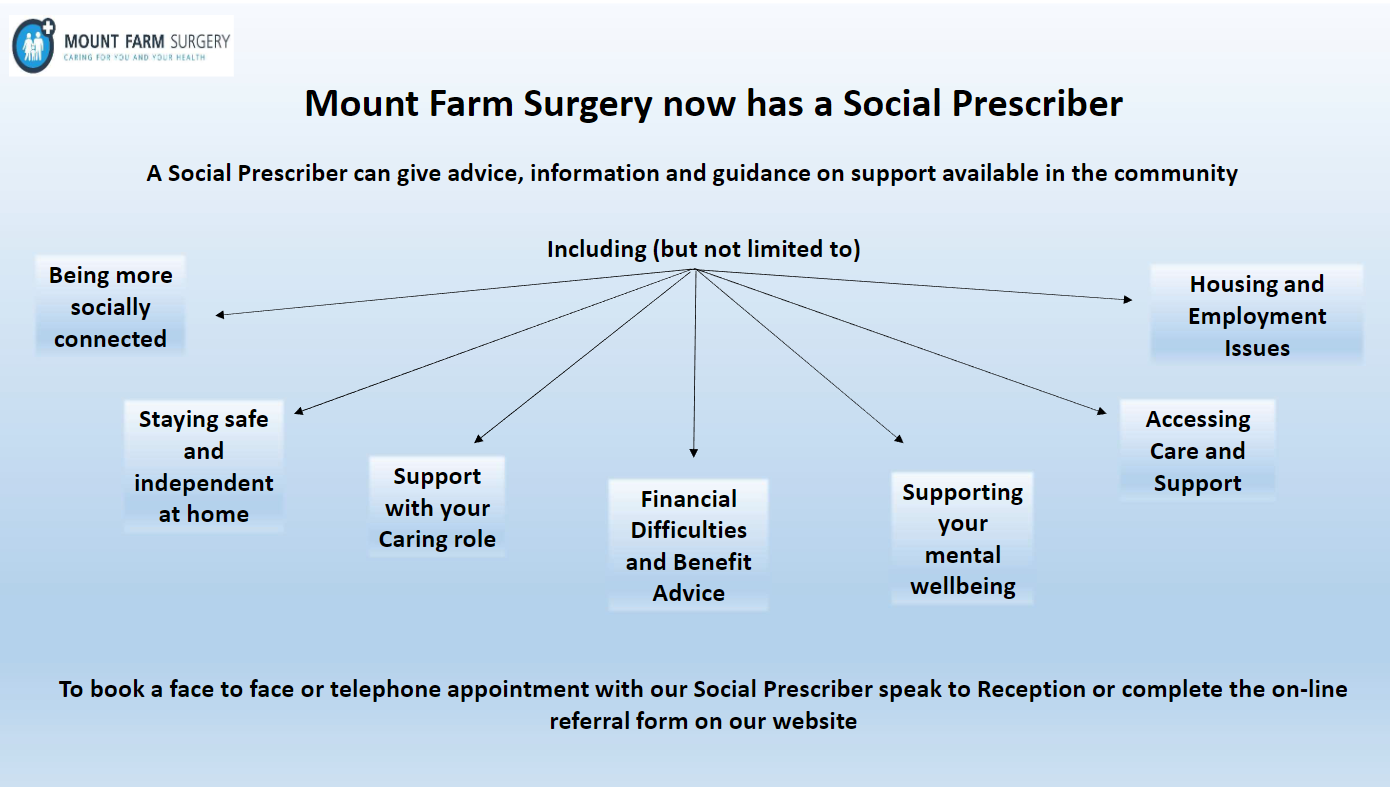
This service is available to adults aged 18 and over who are registered at Mount Farm Surgery and who are experiencing non-medical issues requiring additional support. Please complete the self-referral form below and we will contact you to help and/or arrange an appointment.
We no longer provide a full travel clinic service. We do offer vaccinations that are free on the NHS, but only if recommended; this is subject to there being a suitably-trained clinician available to give them. For travel advice please visit www.travelhealthpro.org.uk or www.fitfortravel.nhs.uk/home.
There are travel clinics based in Cambridge and Bury St. Edmunds. Many pharmacies and supermarkets also now provide this service.
It is the patient’s responsibility to find out what is required for their travel destination, and it is strongly recommended that vaccinations are given at least four weeks prior to travel. We are happy to give these vaccinations subject to an appointment with a suitably-trained nurse being available, however due to recent changes within our nursing team, we now only have very limited capacity for these types of appointment and so would recommend patients contact a pharmacy or travel clinic for their requirements.
Mount Farm has a Silver Pride in Practice Award for excellence in LGBT healthcare. This award demonstrates we have taken meaningful steps to provide lesbian, gay, bi and trans people with a positive, affirming, and equitable service. This award is nationally recognised, and endorsed by NHS England, the Government Equalities Office, and the Royal College of GPs.
Mount Farm is an accredited Veteran Friendly GP practice, which means we have demonstrated we effectively support veteran patients and meet the health commitments of the Armed Forces Covenant. This states that the Armed Forces community, including veterans, should face no disadvantage in accessing health services and should receive priority care for military attributable conditions, subject to clinical need.
Mount Farm is rated as Good for the care of people experiencing poor mental health (including people with dementia).
- 93% of patients diagnosed with dementia had their care reviewed in a face-to-face meeting in the last 12 months, which was above the national average of 84% and CCG average of 82%.
- The practice regularly works with multi-disciplinary teams in the case management of patients experiencing poor mental health, including those with dementia.
- The practice carries out advance care planning for patients with dementia.
- Staff have received training in dementia and a dementia assessment had been carried out of the premises by a dementia friendly employee.